This article was created with AI writing assistance (ChatGPT, Claude, etc.). Product selection, specifications, and reviews are verified by the Japan Life Lab editorial team.
This article contains promotional / affiliate links.
If you live in Japan for more than three months and you are not covered by an employer’s health insurance, you must join National Health Insurance (NHI, Kokumin Kenko Hoken). It is run by your city or ward, it pays 70% of most medical bills, and in 2026 it works a little differently than before: paper insurance cards are gone, a new child-support charge has been added to premiums, and the monthly cap on medical bills changed in August 2026. This guide explains who must join, how to sign up, what it really costs in Tokyo, and what to do when you change jobs or leave Japan.
📋 NHI in 2026 — the key facts
- Sign up within 14 days of moving in, or of losing your employer’s insurance, at your ward or city office.
- You pay 30% of the medical bill at the counter (20% for children before elementary school). NHI pays the rest.
- Premiums depend on last year’s income in Japan plus a flat charge per person. In Tokyo’s 23 wards, a newcomer under 40 with no Japanese income last year pays a flat ¥67,073 a year — about ¥20,100 if the 70% low-income reduction applies.
- New from April 2026: a child and childcare support charge (0.27% of income + ¥1,873 per person in the 23 wards; the per-person part is free for under-18s).
- New from August 2026: higher monthly caps on medical bills, plus a new yearly cap.
- No more paper cards: show your My Number card registered for health insurance, or the eligibility certificate (shikaku kakuninsho) your ward mails you.
Do you have to join NHI?
Everyone registered as a resident in Japan has to be in a public health insurance plan. Which one depends on how you live and work:
| Your situation | Your health insurance |
|---|---|
| Full-time employee, or a part-timer who qualifies for social insurance | Your employer’s plan (kenko hoken) — not NHI |
| Spouse or child supported by an employee | The employee’s plan, as a dependent |
| Freelancer or sole proprietor | NHI |
| International student | NHI |
| Between jobs, job hunting, or working without workplace insurance (for example a working holiday) | NHI |
| Staying three months or less, or on “Designated Activities” for medical treatment or sightseeing and recreation | Not eligible — use travel insurance |
How to sign up for NHI, step by step
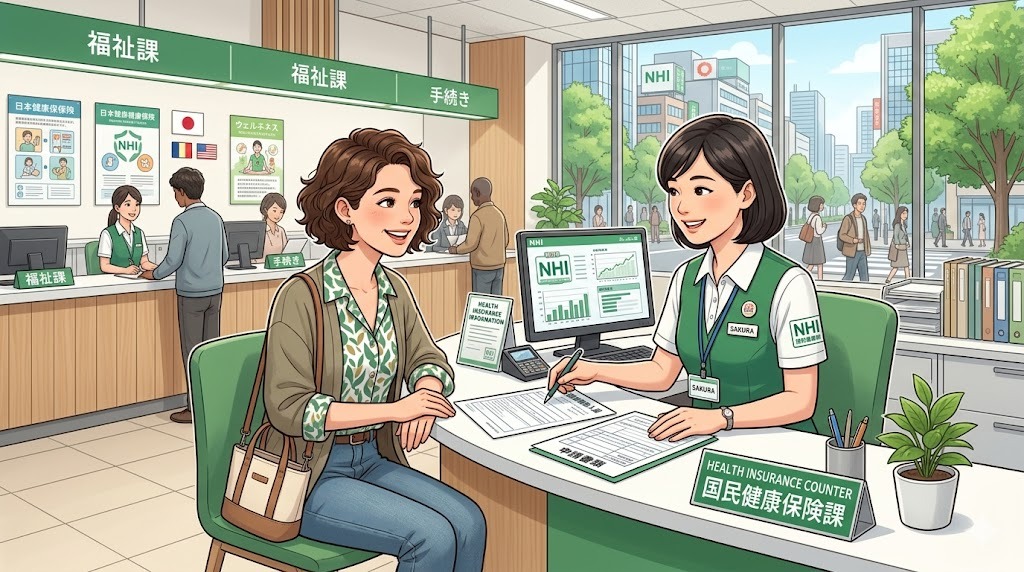
- Go to your ward or city office within 14 days of registering your address, or of losing your employer’s coverage. Most newcomers do it right after the moving-in notice, at the National Health Insurance counter (kokuho madoguchi).
- Bring your residence card, your passport and your My Number card or notice. If you left a job, also bring the paper showing your employer coverage ended (shikaku soshitsu shomeisho).
- Fill in the income declaration if you had little or no income in Japan last year. The ward uses it to apply the low-income reductions — without it, they cannot.
- Set up payment. Automatic bank debit (koza furikae) is the easiest way never to miss an installment. You can also pay with the payment slips at banks and convenience stores.
- Use your coverage with your My Number card registered for insurance, or with the eligibility certificate the ward mails you (see below).
⚠️ Signing up late costs more, not less. If you join late, premiums are charged back to the date you should have joined, and medical bills from that gap are generally 100% yours unless the delay was unavoidable. It works the other way too: when you join a company’s health insurance, you have to cancel NHI yourself at the ward office, or the NHI bills keep coming.
How much does NHI cost in 2026?
Your ward sends the yearly premium bill in June (or the month after you join), split into installments — ten payments from June to March in Tokyo’s 23 wards. The premium has two parts: an income-based part, calculated on last year’s income in Japan minus a ¥430,000 basic deduction, and a flat charge for each insured person. Each part has a yearly maximum per household. If you join partway through the year, you pay only for the months you are covered.
Tokyo 23 wards, fiscal 2026 (April 2026 – March 2027):
| Portion | Income rate | Flat per person | Yearly maximum |
|---|---|---|---|
| Medical (everyone) | 7.51% | ¥47,600 | ¥670,000 |
| Support for elderly care (everyone) | 2.80% | ¥17,600 | ¥260,000 |
| Long-term care (ages 40–64 only) | 2.43% | ¥17,800 | ¥170,000 |
| Child and childcare support (new in 2026) | 0.27% | ¥1,873 (¥0 up to age 18) | ¥30,000 |
Rates as published by Setagaya and Suginami for fiscal 2026. Other cities set their own rates, and most city websites have a premium calculator.
Example 1 — newcomer under 40, no income in Japan last year: only the flat charges apply: ¥47,600 + ¥17,600 + ¥1,873 = ¥67,073 a year. If your household income is low enough for the 70% reduction, and you have filed the income declaration, it drops to roughly ¥20,100 a year.
Example 2 — single, age 30, salary of ¥3,000,000 last year: income after the employment-income deduction is ¥2,020,000; minus the ¥430,000 basic deduction leaves ¥1,590,000. The income part is ¥1,590,000 × 10.58% ≈ ¥168,200. Add the flat ¥67,073 and the total is about ¥235,000 a year — roughly ¥23,500 per installment. From age 40, the long-term care portion (2.43% + ¥17,800) is added.
Low-income households get the flat charges cut by 70%, 50% or 20%, once the ward knows their income. If you cannot pay, talk to the ward before the due date: they can arrange installments, and reductions exist in some situations, such as losing your job involuntarily.
⚠️ Unpaid premiums can now affect your visa. Missed premiums bring reminders, late charges and, eventually, seizure of bank accounts or wages. Japan’s health ministry has said it plans to start refusing visa renewals and changes, in principle, for foreign residents who do not pay NHI premiums, from June 2027. And from fiscal 2026, cities may ask people who arrive from abroad to pay the year’s premiums in advance in one payment — check your ward’s rules when you sign up.
What NHI covers — and what you pay at the clinic
- Doctor visits, hospital stays, surgery, prescriptions and standard dental care. You pay 30% at the counter; children before elementary school pay 20%, and people aged 70–74 pay 20% (30% with a high income).
- Childbirth. A normal delivery is not treated as an illness, but NHI pays a ¥500,000 childbirth lump sum per baby, usually straight to the hospital.
- Treatment abroad. Care you needed during a trip abroad can be partly refunded, based on what it would have cost in Japan. Keep the receipts and a medical certificate. Trips made in order to get treatment are not covered.
- Not covered: general health checkups (members aged 40–74 get a subsidized “specific health checkup” from the city), cosmetic treatment, private hospital rooms, and vaccinations outside the city’s free routine program.
Need a doctor who speaks English? See our guide to English-speaking doctors in Japan.
The monthly cap on medical bills (from August 2026)
The High-Cost Medical Expense Benefit (kogaku ryoyohi) limits what you pay in a month, however large the bill. The caps were raised on August 1, 2026, and a new yearly cap was added. For people under 70:
| Income (last year’s income minus ¥430,000) | Monthly cap | From the 4th time in 12 months | Yearly cap (Aug–Jul) |
|---|---|---|---|
| Over ¥9.01 million | ¥270,300 + 1% of costs over ¥901,000 | ¥140,100 | ¥1,680,000 |
| ¥6 – 9.01 million | ¥179,100 + 1% of costs over ¥597,000 | ¥93,000 | ¥1,100,000 |
| ¥2.1 – 6 million | ¥85,800 + 1% of costs over ¥286,000 | ¥44,400 | ¥530,000 |
| Up to ¥2.1 million | ¥61,500 | ¥44,400 | ¥530,000 (¥410,000 for some) |
| Exempt from resident tax | ¥36,900 | ¥24,600 | ¥290,000 |
Tip: when you use your My Number card at the hospital, the cap is applied at the counter automatically. If you use the eligibility certificate instead, ask your ward how to get the cap applied before a planned hospital stay — otherwise you pay first and claim the excess back later.
No more paper cards: My Number card or eligibility certificate
Japan stopped issuing paper health insurance cards on December 2, 2024. The old cards expired by December 1, 2025 at the latest, and the grace period for expired cards ended on March 31, 2026. Now you show one of these at every clinic and pharmacy:
- Your My Number card, registered for health insurance. You register it once, in the Mynaportal app or at a clinic’s card reader. No card yet? See our My Number card guide.
- An eligibility certificate (shikaku kakuninsho). Your ward mails it, without any application, to NHI members who do not use their My Number card for insurance. You use it like the old card.
If you have neither with you, the clinic may not be able to confirm your coverage, and you may have to pay the full cost first and claim the 70% back later.
Moving, changing jobs and leaving Japan
- Moving to another city: NHI is run by each city. You leave it with your moving-out notice and join again at the new office within 14 days.
- Starting a job with company insurance: take your new insurance details to the ward and cancel NHI within 14 days.
- Losing your job: join NHI within 14 days. If you had at least two months of coverage, you can usually stay on your former employer’s plan for up to two years instead (nin’i keizoku, apply within 20 days) — compare the two costs.
- Leaving Japan: file your moving-out notice at the ward office (you can do it up to 14 days before you leave). Your NHI coverage ends when you leave, and the ward settles your premiums. Then claim your pension refund — see our Japan pension refund guide.
FAQ
Is National Health Insurance mandatory for foreigners in Japan?
Yes. If you are registered as a resident with a stay of more than three months and you are not covered by an employer’s health insurance as an employee or a dependent, you must join NHI at your ward or city office within 14 days.
How much is NHI in Tokyo?
It depends on last year’s income in Japan. In Tokyo’s 23 wards in fiscal 2026, a newcomer under 40 with no Japanese income pays a flat ¥67,073 a year (about ¥20,100 with the 70% reduction), while a single person who earned a ¥3 million salary pays about ¥235,000 a year.
Can I still use my old paper insurance card?
No. Paper cards expired by December 1, 2025, and the grace period ended on March 31, 2026. Use your My Number card registered for insurance, or the eligibility certificate your ward mails you.
What happens if I don’t pay my NHI premiums?
You get reminders and late charges, and the city can eventually seize bank accounts or wages. The health ministry has also said it plans to refuse visa renewals in principle, from June 2027, for foreign residents who do not pay.
Do international students have to join NHI?
Yes. Students staying longer than three months must join. With little or no income the premium is usually reduced, so file the income declaration when you sign up.
How much will I pay for a hospital stay?
You pay 30%, but the High-Cost Medical Expense Benefit caps it. From August 2026, someone whose income after the basic deduction is ¥2.1–6 million pays at most ¥85,800 plus 1% of costs above ¥286,000 in a month.
Sources (checked October 2026)
- Setagaya City — fiscal 2026 NHI premium rates
- Suginami City — fiscal 2026 rates and payment schedule
- Minato City — High-Cost Medical Expense caps from August 2026
- Okayama City — eligibility certificate
- Sapporo City — when to notify, and eligibility for foreign residents
- Itabashi City — late enrollment
- Meguro City — childbirth lump sum
- Ministry of Health, Labour and Welfare — Q&A on paying premiums in advance
- Tuoi Tre News — plan to refuse visa renewals from June 2027
🏥 More Expat Life Guides
🗾 More Japan Life Guides
Japan Expat Starter Kit 2026 PDF guide
Your first 90 days in Japan, step by step: 17 chapters · 24 pages · 100 phrases in Japanese script · 40 kanji · printable checklists. Bank account, My Number, health insurance, apartment, phone, taxes & pension.
$9.99 $4.99 current price
📥 Get the kit →📄 Read 5 pages free: contents + Chapter 2
⚡ Instant PDF download · 🛡️ 30-day money-back guarantee · 🔄 Free 2026 updates
🔥 Editor’s Picks for Life & Travel in Japan
Practical guides for life and travel in Japan — free, about once a week. No spam, unsubscribe anytime.
☕ Enjoying our Japan guides?
If this article helped you, you can support our work with a coffee!
🇯🇵 Travel & Life Essentials for Japan
Hand-picked gear to make your time in Japan easier. Available on Amazon US & Amazon Japan.
🔋 Portable charger
A must for long days of sightseeing and photos.
View on Amazon (US)View on Amazon Japan🔌 Travel plug adapter
Japan uses Type A outlets. Bring the right adapter.
View on Amazon (US)View on Amazon Japan🎧 Translation earbuds
Real-time translation to talk without barriers.
View on Amazon (US)View on Amazon JapanAs an Amazon Associate, Japan Life Lab earns from qualifying purchases.
Did this guide help you? 🍵
Japan Life Lab is a small independent blog, and every guide we publish is completely free — no paywalls, ever. If our work saved you time (or a headache), you can support us with a cup of Japanese tea. Every contribution, big or small, goes straight into keeping these guides free, accurate and up to date for everyone.
☕ Support Japan Life Lab
Leave a Reply